Listen to the sermon with the player below, or, download the audio.
+ + + In Nomine Jesu + + +
Please join me in prayer: May the words of my mouth and the meditations of our hearts be pleasing in your sight, O Lord, our Rock and our Redeemer. Amen.
Dear Brothers and Sisters in Christ,
Grace to you and peace from God our Father and from the Lord Jesus Christ. (Amen.)
The last four weeks of this Lenten season, we have heard the Divinely‑inspired St. Luke’s account of the Passion of our Lord Jesus Christ narrate how Jesus Himself, having come out from a furnished large Upper Room, journeyed to the Mount of Olives (Luke 22:12, 39), and, there, how the chief priests and officers of the temple and elders, having seized Jesus, led Him and brought Him into the High Priest’s House (Luke 22:54) and then how the whole company of the elders of the people, both chief priests and scribes, essentially the Sanhedrin, arose and brought Jesus before Pilate, who ultimately delivered Jesus over to their will to be crucified (Luke 23:1, 25). In tonight’s Reading, presumably the Roman soldiers led Jesus away to the place that is called “The Skull”. So, as we tonight conclude this Lent’s Special Sermon Series themed “Places of the Passion according to St. Luke”, this fifth and final sermon focuses on “The Skull”. Although, tonight’s Reading begins where Pilate was in Jerusalem, describes what happened on the way to “The Skull” outside of the city, and tells how the body of Jesus was taken to a tomb, which St. John uniquely reports was in a “garden” (John 19:41-42; confer Matthew 27:60; Mark 15:46), the central action of tonight’s Reading is at “The Skull”.
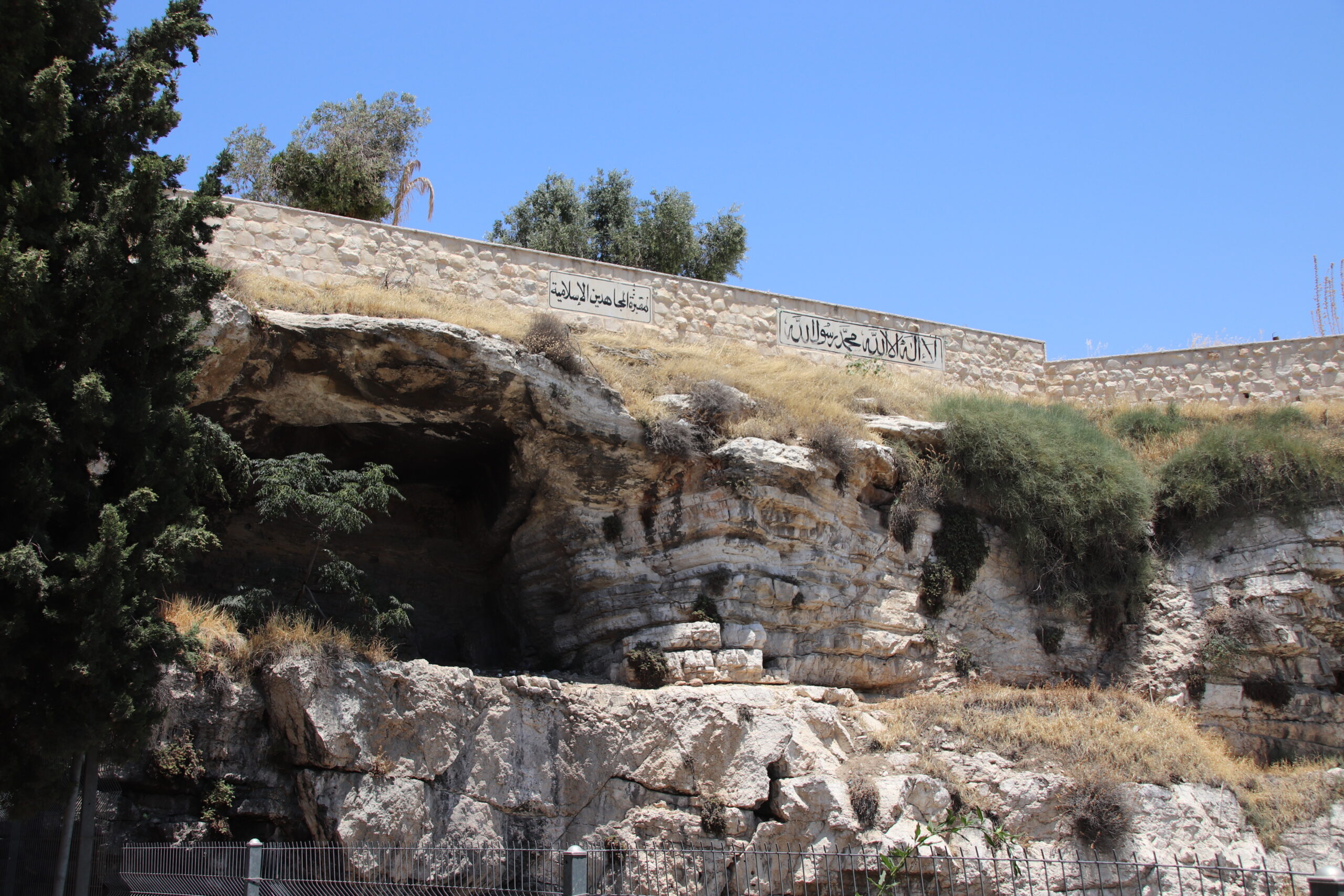
Gary Todd’s July 9, 2018, picture of Skull Hill and the Garden Tomb in Jerusalem is from here and has been dedicated to the public domain.
.jpg)
The precise locations of Jesus’s crucifixion and burial are matters of some debate. The picture on the front of tonight’s service outline shows one possibility, what is called “Skull Hill and the Garden Tomb”. St. Luke’s Gospel account simply calls the place by the Greek words τὸν Κρανίον, which means “The Skull”, while the accounts of Saints Matthew, Mark, and John use both the Greek phrase “Place of a Skull” and the transliteration of its Hebrew equivalent “Golgotha” (Matthew 27:33; Mark 15:22; John 19:17; confer Judges 9:53; 2 Kings 9:35). The Latin equivalent calvaria gives us the English name “Calvary”, as we sang in the Office Hymn (Lutheran Service Book 435), but modern Bible versions usually transliterate “Golgotha” and translate τὸν Κρανίον into their target language, such as English. Why exactly the place was called “The Skull” is somewhat uncertain. The usual explanation is that the place looked like a skull, although at least one author says that that explanation “demands imagination and an easy credulity” (Clark, TIDOTB, s.v. “Golgotha”, II:439). An early Christian tradition held that the name came from the skull of Adam’s being buried under the cross, as pictured in medieval art, and recently I heard the suggestion that the skull of Goliath of Gath, who was slain by David, and which skull was taken to Jerusalem (1 Samuel 17:54), gave the similarly‑sounding “Golgotha” its name. Perhaps the name “The Skull” simply represented the punishment of death that was carried out there.
On the way to “The Skull”, as we heard in tonight’s Reading, the soldiers made Simon of Cyrene carry likely the crossbeam behind Jesus, and there followed Jesus a great multitude of the people and of women, women who were mourning and lamenting for Jesus. As St. Luke uniquely reports, Jesus, referring to the destruction of Jerusalem that would come some 40 years later, essentially told the women that they had greater reason to weep for themselves and for their children, as Jesus Himself had done just days earlier (Luke 19:41-44). In Old Testament language repeated in Revelation (Hosea 10:8; Revelation 6:16), Jesus describes the people subject to that destruction’s calling on the mountains and hills, not to hide and protect them, but to fall on them and to kill them, perhaps providing a quick temporal death but not avoiding the eternal death that we all deserve and that any un‑repentant people will suffer.
Once at “The Skull”, as we heard in tonight’s Reading, the rulers were scoffing at Jesus; the soldiers mocked Jesus; and, as St. Luke narrates it, one of the criminals was blaspheming Jesus. They all seemed to admit both that Jesus was the Christ of God, His Chosen One, the King of the Jews, and that Jesus had saved others. The one criminal in particular wanted Jesus to save him, apparently by getting him off of the cross, while the other criminal, who St. Luke’s Greek text says was of a different nature, wanted Jesus to “save” him, we could say, by remembering him, not just by having him in mind but by acting accordingly, when Jesus came into His Kingdom. That criminal confessed Jesus’s innocence and his own guilt and trusted Jesus to forgive him, while the other criminal did not. Such striking contrast! Such were the two different reactions of the two criminals hanged with Jesus as prophesied (Isaiah 54:12; Luke 22:37), and such are the two different reaction of people throughout history, including even us today. Do we in some sense “know” Who Jesus is but not repent? Or, do we know Who Jesus is and repent? When we turn in sorrow from our sinful nature and all of our sin and trust God to forgive us for Jesus’s sake, then God does forgive us, our sinful nature and all of our sin, whatever our sin might be.
On the way to and at “The Skull”, as we heard in tonight’s Reading, Jesus was mostly focused on others. Jesus warned the women about Jerusalem’s coming destruction. In love, Jesus interceded for those responsible for His crucifixion. And, Jesus absolved the penitent criminal and assured him of his presence with Jesus in eternal life. At least indirectly, we hear what Jesus was all about! St. Luke’s account does not give us verbose blood‑splattering graphic-detail but with one Greek word simply tells us that, at “The Skull”, “they crucified” Jesus. While Jesus hung on the cross naked, the soldiers gambled away His garments, in keeping with Old Testament prophecy (Psalm 22:18; confer John 19:23-24). Yet, Jesus remained in control through His last breath, resisting temptations to come down from the cross (for example, Matthew 27:40, 42) and instead voluntarily giving His life the sins of the world, including your sins and my sins. The rulers, soldiers, and im‑penitent criminal reasoned falsely that the Christ Who saved others should save Himself, not realizing that only by not saving Himself could He truly save others (confer Ac 13:27; 1 Corinthians 2:8). The centurion who saw what had taken place praised God, saying Jesus was “innocent”, or vindicating Him as “righteous”, as Pilate had repeatedly declared Jesus to be “not guilty”, and perhaps as St. Luke was indirectly appealing for St. Paul to be so declared by Caesar decades later (for example, Acts 28:19).
While Jesus was crucified at “The Skull”, the curtain of the temple, likely the curtain between the Holy Place and the Most‑Holy Place, was torn in two. Neither St. Luke nor the other evangelists explicitly say what that tearing of the curtain means, though that does not stop people from speculating, perhaps falsely, that it means such things as people’s thereafter having direct access to God, as if the average worshiper would have even known that that curtain was torn—there were still other curtains or doors and gates that kept them from the Most‑Holy Place—and as if the average worshiper did not already have direct access to God, such as through prayer. We know that the high priest went through that curtain only once each year, on the Day of Atonement and with the blood of the sacrifice. Once Jesus’s death fulfilled that Old Testament sacrificial system, there was no more need of annual sacrifices for atonement. The Most‑Holy Place had been empty for some time, and the presence of God was in the “temple” of Jesus’s flesh (John 1:14; 2:13-22). Now, we find God present in order to forgive us in His Word read and preached, in His Word with water in Holy Baptism, in His Word with touch in Holy Absolution, and in His Word with bread that is Christ’s Body and with wine that is Christ’s Blood. God sends His ministers to preach the Gospel and administer the Sacraments and so gives the Holy Spirit and forgiveness of sins in all of these ways through which He has promised to be present with us and to forgive us who repent.
Another contrast in tonight’s Reading about “The Skull” is perhaps that contrast between the women of Jerusalem, who piously mourned and lamented for Jesus, and the women who had come with Him from Galilee, who stood at a distance watching Him die, saw the tomb and how His body was laid, returned and prepared spices and ointments, and rested on the Sabbath according to the commandment. The women from Galilee loved their Lord and served Him as they knew best, according to their callings in life, earlier providing for Him and His disciples out of their means (Luke 8:1-3) and preparing to treat His body to make mourning Him at the tomb more pleasant. Transformed by God through faith, we also love our Lord and serve Him as we learn is best, according to our callings in life, providing for the work of His Church in this place, denying ourselves, and taking up our cross daily and following Him (Luke 9:23). With daily repentance, we receive His forgiveness for all of our failures, knowing that the day is coming when we, too, will be with Jesus for eternity in Paradise.
This evening we have considered the fifth and final of five “Places of the Passion according to St. Luke”. In what happened at “The Skull”, we again found contrast, contrast such as the contrast between the im‑penitent and penitent criminals, and the contrast between the women of Jerusalem and the women of Galilee. We considered our sin and, for Jesus’s sake, God’s forgiving us, who repent, through His Means of Grace. At the end of tonight’s Reading, Jesus’s body is resting in the tomb to rise on the third day, and, after this Lenten season, we, as God wills, and with God’s grace and blessing, are “prepared joyfully to celebrate the paschal feast in sincerity and truth” (for example, Lutheran Service Book, 230.
Amen.
The peace of God, which passes all understanding, keep your hearts and minds in Christ Jesus. Amen.
+ + + Soli Deo Gloria + + +